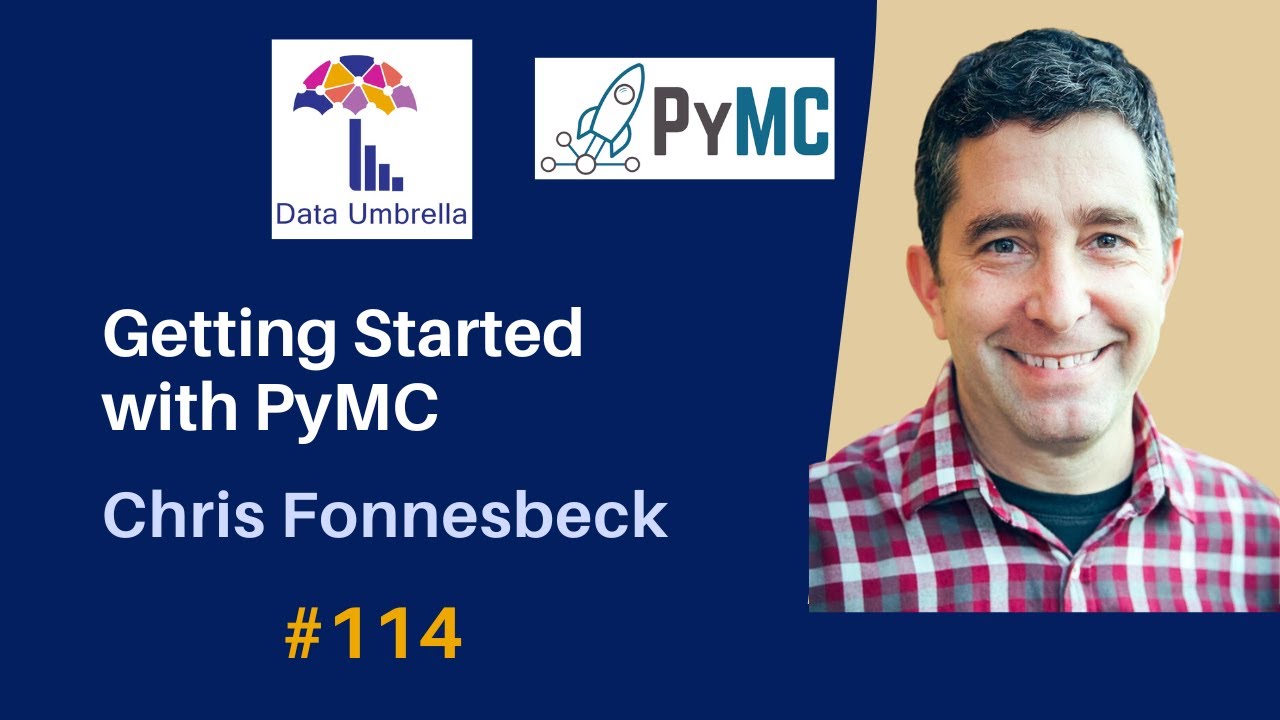
A Tutorial for Getting Started with PyMC
- Topic: probabilistic programming in Python
- Title: A Tutorial for Getting Started with PyMC v5
- Date: Tues, Aug 12, 2025
- Time: 9am PT / 12pm ET / 16:00 UTC
- Registration options:
- Via Meetup (lets you know of upcoming events): [Online] A Tutorial for Getting Started with PyMC, Tue, Aug 12, 2025, 12:00 PM | Meetup
- Directly to the Registration Form
- Cost: Free

This one-hour tutorial introduces new users to version 5 of PyMC, a powerful Python, open source library for probabilistic programming and Bayesian statistical modeling. Participants will learn the fundamentals of PyMC, best practices for installation and setup, and gain hands-on experience building their first Bayesian model.
Background
WinBUGS, released in 1997, was the first software to provide an alternative to manually coding samplers for Bayesian models. However, it had a number of limitations. WinBUGS and OpenBUGS provided invaluable experience in Bayesian modeling for beginners, and paved the way for the development of PyMC as well as other tools that made it easier to implement Bayesian inference methods.
In 2003, Chris Fonnesbeck began writing the first version of PyMC, with the goal of being able to build Bayesian models in Python. PyMC 1.0 was released in 2005. Learn more about the history of PyMC up to 2023 here: PyMC: Past, Present, and Future — PyMC project website
PyMC has experienced an estimated 40-60% adoption growth since 2022, establishing itself as the most accessible entry point for Python developers into probabilistic programming through its intuitive syntax and seamless integration with the PyData ecosystem. While Stan remains the academic gold standard and NumPyro excels in raw computational performance, PyMC’s recent JAX integration now delivers competitive speed while maintaining the familiar, Pythonic workflow that makes Bayesian modeling approachable for newcomers.
Prerequisites
- Basic Python programming knowledge
- Familiarity with NumPy and basic statistics
- Optional: watch the video on the history of PyMC: PyMC: Past, Present, and Future — PyMC project website
Resources
- pymc.io: Home — PyMC project website
- PyMC video playlist: https://www.youtube.com/playlist?list=PLBKcU7Ik-ir99uTvN0315hIVLuyj4Q1Gt
Event Outline
1. Introduction to PyMC and Probabilistic Programming
- What is PyMC and its role in the Python data science ecosystem
- Understanding probabilistic vs Bayesian approaches
- The probabilistic programming landscape
- Real-world applications and case studies
2. Installation and Environment Setup
- Recommended installation procedure
- Understanding PyMC’s computational backends
- Troubleshooting common installation issues
- Setting up development environments
3. PyMC Fundamentals
- Model contexts and random variables
- Prior and likelihood specification
- Working with observed data
- Understanding PyMC’s relationship with ArviZ
4. Building Your First Model
- Hands-on example: Bayesian linear regression
- Prior predictive checks
- Posterior sampling with NUTS
- Basic model diagnostics
- Posterior predictive checks
5. Common Pitfalls and Solutions
- Addressing frequently asked questions
- Debugging convergence issues
- Understanding and fixing divergences
- Performance optimization tips
6. The PyMC Ecosystem and Resources
- ArviZ for visualization and diagnostics
- Related packages (Bambi, PyMC-experimental)
- Finding and using PyMC example notebooks
- Community resources and support channels
7. Future Directions
- How AI/LLMs are changing PyMC workflows
- PyMC’s development roadmap
- Opportunities for contribution
How to Join the Webinar
You can join via your browser (no app download required). Use Chrome or Firefox. Pre-register for the webinar:
Video Recording
This event will be recorded and placed on our YouTube. We usually have it up within 24 hours of the event. Subscribe to our YT and set your notifications: https://www.youtube.com/c/DataUmbrella/
Time
16:00 UTC, 9am PT / 12pm ET / 6pm Paris / 7pm EAT / 9:30pm IST (Daylight Savings Time)
Additional Details
Talk Level: Beginner
About Speaker
Chris is a Principal Quantitative Analyst at PyMC Labs and an Adjoint Associate Professor at the Vanderbilt University Medical Center, with 20 years of experience as a data scientist in academia, industry, and government, including 7 years in pro baseball research with the Philadelphia Phillies, New York Yankees, and Milwaukee Brewers. He is interested in computational statistics, machine learning, Bayesian methods, and applied decision analysis. He hails from Vancouver, Canada and received his Ph.D. from the University of Georgia.
LinkedIn: https://www.linkedin.com/in/christopher-fonnesbeck-374a492a/
GitHub: fonnesbeck (Chris Fonnesbeck) · GitHub
Bluesky: @fonnesbeck.bsky.social on Bluesky